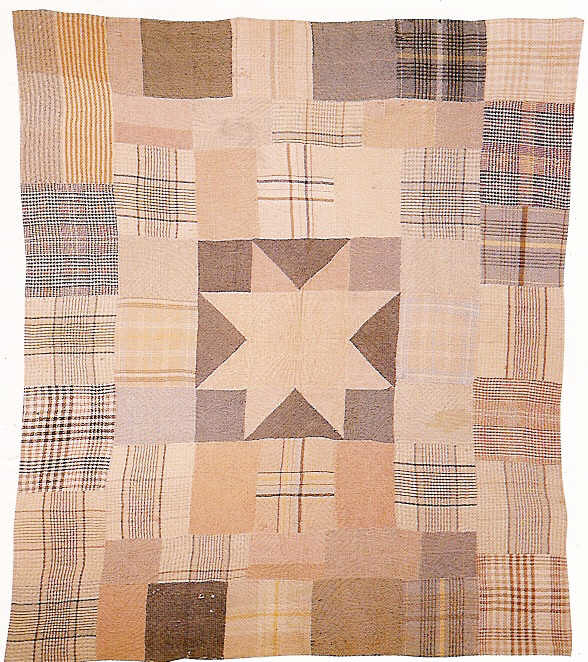
I don't do replicas but prefer to say that I am "inspired by" or make "in the spirit of". Anyway it is impossible to replicate a Welsh wool quilt because the fabrics used then are no longer made.
There was a period in our history when our quilts were entirely homegrown; the woollen cloth was manufactured in our mills and made from the fleeces of the thousands of sheep grazing our hilly countryside. Clumps of this wool were often gathered from the hedgerows by the quilters and cleaned and carded to use as padding in their quilts. Sometimes the cleaning process wasn't too thorough and many quilts were ruined when washed because - well I will leave it to your imagination!
I saw this picture on the Internet a while ago -
It was from an exhibition of Welsh Quilts from Ceredigion Museum held at the Green Mountain College in Vermont. I had never seen this quilt before and immediately thought that I could do a scaled down version and make it into one of my Little Welsh Quilts. The original quilt was made of woollen cloth but I used cotton fabric from my stash. I based the colours on the picture but when I eventually saw the original quilt I hadn't quite got it right. Instead of blue surrounding the central red star, it should have been dark green! But hey, it's not a replica so it doesn't matter!
I made up my own quilting design because as my quilts are small there is less room to do the large swirling patterns of full sized bed quilts, so one has to choose motifs carefully so as not to distort the patchwork. Now when I look at the finished quilt I feel that I should have done a bit more quilting, but it's difficult to go back and as I have a stack of little quilts waiting to be quilted it may never get done?
Sunday, 17 October 2010
Thursday, 14 October 2010
This time a Welsh Quilt with mugs and a jug
I want to show you some favourite things in a favourite place. They belong to great friends of mine and are photographed at their delightful cottage deep in the Welsh countryside. It was recently featured in BBC Home & Antiques magazine and it is both lovely to look at and comfortable to be in, which isn't always an easy combination to achieve.
This is a group of their mocha ware mugs and just one jug. I share their love of mocha ware and have a few pieces too, but Philip has grouped these in front of a large Star Quilt. Here is a longer view in which you can see more of the pattern -
I have seen other Welsh quilts of this design and at first glance it wouldn't strike one as a Welsh quilt, but it is and the element that confirms this is it's Welsh quilting patterning with all the familiar motifs of spirals, leave etc.
This is a view through their back door, isn't it an inspiring place?
Christine and Philip are antique dealers and they have access to wonderful things and though they have many in their cottage, it is it still very much a home.
If you would like to see their website here is the link -
http://www.havardandhavard.com/
Sunday, 10 October 2010
Celebrating and commemorating in Wales
I no longer do embroidery - well only an occasional bit like a label or a centre for a quilt. It's strange really,
it's almost as if my embroidery button has been switched off. I am still a member of the Embroiderers' Guild so I am still in touch with that world but now I concentrate on making quilts and trying to quilt my patchwork tops - I have about 20 in the queue, but I keep making new ones and the queue gets longer!
Before this happened I embroidered a sampler of our house to commemorate its 100th Birthday. The whole street of 32 houses celebrated their houses' centenary by having a street party. It's a lovely street to live in as there's still a community spirit and we are always ready to party! We gained permission from the Council to close the road and for several hours we played host to some high profile guests, including our MP and AM and other dignitaries. It was a joyful occasion with food, wine, music and lots of games for the children and we had a wonderful sunny day too! Afterwards we erected a plaque on the end house to mark the occasion.
This is the top part of the sampler, I omitted the bottom part because it listed quite a few details which I didn't want on the Internet, but it started life as a band sampler and is in that style. For cat lovers, if you look you will see my black cat Frank trotting along the side path to the front door. I always used to try and include him in my embroideries, as a little touch of black does wonders!
We are now carrying on pouring money into our houses to keep them up and running for another 100 years!
Wednesday, 6 October 2010
My Sampler Book
In what seems now like a former life, I wrote a sampler book, which was first entitled HOUSE AND GARDEN SAMPLERS. However, there was trouble with that title, as a multi national magazine company had a publication using the words house and garden as a title (I am sure you know which one) and they raised objections. I believe a deal had to be struck before my book could be published.
All this seemed unbelievably petty, as no one thought that such common words like house and garden could be a protected trademark, but litigation had to be avoided. This together with management changes at my publisher didn't help my little book get off to a good start and though it had excellent reviews, it wasn't a best seller.
Despite all this I am very glad I wrote it. There was such a lot of me in that book and as I was teaching in Adult Education at the time, it became my teaching manual and so was very useful. It can still be found on Amazon under its original name and under a different one CREATE YOUR HOME IN COUNTED THREAD, a rather unwieldy title I think?
Sadly this change of name together with a different cover was confusing and I heard that people bought it thinking it was a different book. You have to draw your own conclusions about that. All I know is that I, as an author, had no influence at all on any of these decisions.
There is a great deal wrong with publishing as it was and for the moment, still is, but as technology is changing rapidly they will have to change too, as did the music industry. But it all seems to be taking far too long!
My next book will be published in a different way with a publisher who is thinking of the future and consults her authors. I will tell you all about it soon!
Friday, 1 October 2010
The Spirit of Welsh Quilting
I am now going to bang the drum a little, because I have a passion I want to share with you.
In country areas of 19th century Wales quilting was an organic process and perfection was not the goal. Those who could afford to employ a quilter paid them per quilt and not for their time spent quilting. Quilters therefore had to be very practical and when they made a mistake they did not waste time unpicking but just kept going and disguised inconsistencies within their subsequent patterning. This gave their work a vitality that sets it apart, as no two quilts were ever alike.
I really admire this approach and try to follow it myself. I prefer it to the way quilting developed in 20th century when perfection became the goal. When classes and competitions seem to iron out inconsistencies and the quilts made, though beautiful became, in my opinion, rather soulless.
Of course it had to be this way because the Rural Industries Bureau was promoting and helping to sell quilts in London galleries, so the idiosyncratic style of earlier quilters would not have been acceptable. We don't have these pressures now as most of us quilt because we enjoy it, so unless we want to win a prize, we are free to return to the traditional organic approach of the 19th century.
There is so much more to quilting the Welsh way than by using a light box to trace a printed pattern onto cloth and then painstakingly follow the drawn lines with quilting stitches! True Welsh quilting requires imagination and innovation for the quilter to imprint her personality upon the cloth.
Just look at this picture to see how wonderfully free the quilting was - look how the leaves are so wobbly and the spirals aren't all even -
This quilt wouldn't win a rosette today because now quilting is judged differently. Are we wrong in our values? What do you think?
This quilt is in the Jen Jones Collection, thank you Jen for allowing me to photograph it and share it with others.
Wednesday, 29 September 2010
The Welsh Quilt that got away!
A few years ago when Clare and I were working on MAKING WELSH QUILTS I spotted a picture of an old Welsh quilt in Pepper Cory's book MASTERING QUILT MARKING (Hi Pepper - I love this book!) and I thought it would make a good project for our book (we did ask Ardis and Robert James for permission to do this).
I quickly drafted it on my favourite squared paper and Clare made it with pieces from her stash. She then quilted it beautifully using many of the patterns on the original. We called it Pennsylvania Echo, because it seemed like a good idea at the time and it is in the book if you want to make one.
This is the link to the original quilt -http://www.quiltstudy.org/collections/search.html?search_type=advanced&search_action=advanced&totalresults=9&offset=0&maxresults=10&detailresult=3&sortby=PatternPrimary
It is much larger than our little quilt and of course the fabrics are very different. It couldn't be in a better place to be appreciated and cherished, but I do feel that it is a shame that it has left Wales.
I believe that it it is an important quilt for a few reasons. Firstly it is very early for this style of quilt and secondly it is actually dated 1818, which is rare. It is made of a mixture of wool and silk and when I drew it to the attention of Dorothy Osler, she and Debbie Harries did extensive research on the fabrics and produced a research paper for Quilt Studies (published by the British Quilt Study Group).
So it is a very special quilt and in a perfect world it should be here in a Welsh museum. But hey ho, we have so much heritage that we don't value it as much as we should. It is safe where it is in the USA and after all it really is their heritage too!
The above link to the old quilt doesn't seem to be working consistently, if you see the wrong quilt (and it's obvious) copy and paste the web address into your browser.
Monday, 27 September 2010
Inspired by Welsh Blankets
Welsh blankets are now widely collected, I don't own any and am reluctant to start because I have so much other stuff. However, their colour and design content does inspire me and it all began with this simple quilt owned by Ron Simpson made with pieces of blanket -
I love its subtle colours and as I don't usually work with this colour palette, it was a challenge and I had to dig deep in my stash to find suitable fabric and use what I had creatively. This is the result -
I used my then limited collection of shirtings and added a few fabrics that a Japanese friend had left me before returning home. I enjoyed working with these shades so much I began to collect Japanese woven fabrics and I have used them in quite a few quilts since. This is a better picture of the quilting -
Subscribe to:
Posts (Atom)