The Cottage Orné Quilt

The Cottage Orné Quilt
Click the picture to visit my other blog

Tuesday, 6 September 2011

Luscious Welsh quilting

 This is another of my favourite quilts from the Jen Jones Collection. It was made in Pembrokeshire in the late 19th century .  If you click the picture and zoom in you will see that the quilter has very carefully placed the urn of flowers over the central patchwork pieces -


Jen has kindly allowed me to use the images to illustrate a piece I am writing for the Winter edition of "The Quilter", the magazine of the Quilters' Guild of the British Isles and I thought you might like to see them too?

The reverse of the quilt isn't usually on display of course, but it could stand alone as a whole cloth, which I know many of you are interested in. I personally I am not keen on cross hatching, but it does fill a design without too much cudgelling of the brain and it is a good way of coping with a rectangle!  As as you can see from this close-up, the quilting is yummy!


Friday, 2 September 2011

My new blog - The Cottage Orne Quilt

This post is a blatant plug for my new blog  " The Cottage Orne Quilt" which I have just published somewhere in the ether - please visit me there?.  Here is the linkhttp://cottagenornequilt.blogspot.com/

As you know I am a great admirer of the Sundial Coverlet in the collection of the Victoria & Albert Museum and ever since last summer when I saw it exhibited, I have been spasmodically working on a tribute project.   It is a long term commitment sandwiched between my other work.  I thought it was be good to do another blog about it so that it does not impinge on this one which I will still be doing as usual.


Over the years I have accumulated a  file of  photographs of this coverlet and have studied its details minutely.  I drafted and worked some blocks last Autumn but had to put it on hold while I worked on my Little Welsh Quilt ebook.  Now I am ready to begin again. It is a challenging project because the maker "MCB" was a very skilled piecer, much more skilled than I am,   However, it does one no harm to be humbled by someone who lived in the time of Jane Austen!  It was obviously an age of clever women!

I can't resist showing you this picture of Bella - I just happened to have my camera on my work bench bedside me!  She doesn't meow like any normal cat, so has to think of ways to attract attention - this is the latest way, sitting on my monitor and staring at me. I do have a have a slimline one (monitor not cat) but I haven't changed to it yet, I'm scared everything will disappear!
 

Tuesday, 30 August 2011

Gees Bend and Cassandra Ellis

I have made another discovery through the Needleprint blog - Cassandra Ellis who makes commissioned memory quilts.  I love her blog and her philosophy and she says that one of her influences is the work of Gees Bend!


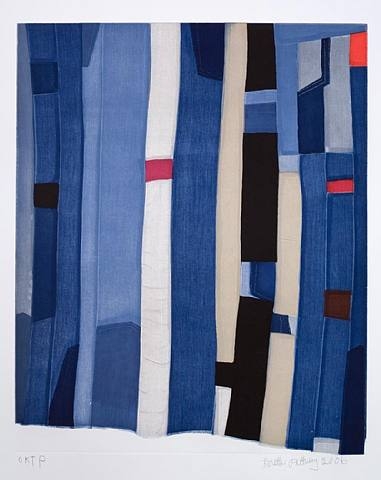
As you can see from the above, Gees Bend quilts make great images which grab attention, but I am rather uncomfortable about the whole Gees Bend phenomenon.  I'm not sure why, it's probably because when something becomes the thing to admire, I am suspicious.

Some of you will have seen these quilts on exhibition, I have not, so I have absolutely no idea of their quality.  Are they well made?  Do they work as quilts, as presumably they were made as quilts even though now they are treated as art?  How do you feel that they are now so revered?

Cassandra Ellis makes commissioned quilts using fabric that has personal meaning to her customers.  She also does workshops encouraging her students to bring and use their own fabric collection, especially if the pieces are meaningful to them.  She believes in re-cycling fabric as it adds a another dimension to the work produced.  She is making a stand against the commercialism of the quilting industry and I am all for that.

I admire her approach which is to enthuse and encourage people to cross boundaries and make something very personal.  I wish I could, but after years making patchwork by hand I can't switch to the sewing machine and do improvised piecing.  My patchwork is not free and easy and I am terrified of doing "lumpy" work - a word my dear late friend Gill Thompson used to categorise below standard workmanship.

This brings me back to my questions about Gees Bend and their quality.  If they are made to be quilts they should be judged by quilt making standards.  Viewing them as art is just confusing everything and denigrating quilt making.  I should love to know what you think?

Friday, 26 August 2011

Designing a quilting plan and Mrs. Lace

First of all please forgive this really bad picture, it's actually a photo of a photocopy of a quilt found in an ancient out of print book by the Dryad Press.  It's the only record of a wonderful whole cloth quilt which we wanted to include it in MAKING WELSH QUILTS but couldn't track down.

The quilt was made by Mrs Lace of Aberdare, a famous quilter and teacher and is very typical of her work.  If you double click the picture and zoom in you will be able to see it more clearly.


I wanted to feature this design because I think it demonstrates how bold and dramatic good Welsh quilting can be.  It has a format that was used in so many Welsh quilts - a large central circle set in a rectangular field with a large enough border area to give scope for some dramatic quilting.  You won't go far wrong it you stick to it - a circle, set in a rectangle or square and then surrounded by a border, or more borders if you need a larger quilt, but don't make them all the same size, vary them. 

These three main areas would be marked first.  Then the primary motifs, hearts and flowers for the centre and the swirling Paisley pears and fans in the rectangular field would have been marked next.  Everything else - the infill patterning such as spirals, flowers and smaller leaves were marked last, if at all, as many quilters, like Mrs. Lace, were experienced enough to make them up as they stitched. 

A square field, with its equal proportions, is easier to mark out than a rectangle. In this design, Mrs. Lace has cleverly used the swirling Paisley pears to lead your eye around the rectangle. Had the field been square these Paisley pears would have linked up but not in a rectangle, so the side spaces were filled by a flower and leaves which works well.  Clever Mrs. Lace!

The only part I am not so keen on is the border, I think I would have gone for some wonderfully curved leaves.  However by using this fan shape formed by lines, Mrs Lace has again given herself some scope to adjust the number of lines to fill the required area - again a clever way of coping with the dimensions of a rectangle.


Mrs Lane kept a notebook when she began to make quilts during a long coal strike in 1907, to help feed her three small children. She was paid five shillings for the first quilt and from five to twelve shillings for others, according to pattern; during the year she earned ten guineas by making twenty-six quilts an average of about eight shillings.

I hail you Mrs.Lace, you are not forgotten! 


Tuesday, 23 August 2011

Precious Reds


This is one of the quilts from my new ebook which I thought you might like to see?  It's called "Precious Reds" because is is made with pieces of  very cherished red fabric, many of which I have had for a long time - so full of memories!  (Don't forget you can double click and zoom in on the pictures to see more detail)

 I just read this great crit on Amazon co.uk.  If any of you wrote it - thank you so much! Is there anyone who would do one on Amazon.com?  It would be such a help as a small publisher certainly needs it!

Most Helpful Customer Reviews

5.0 out of 5 stars delightful, 20 Aug 2011
By 
I. Mrs Iredale "cumbrian lady" (Cumbria) - See all my reviews
(REAL NAME)   
This review is from: Little Welsh Quilts: Made the Traditional Way (CD-ROM)
An excellent item. I've never had an ebook before but this was v simple to use. It's a comprehensive quilting guide,informative, full of interesting Welsh history. The instructions are excellent with plenty of good photos, ideal for both the beginner & expert quilter. I especially love the easy to print off quilting & patchwork instructions. Mary, you have really fired up my enthusiasm to have a go at Welsh quilt making. So pleased to have bought this.

Friday, 19 August 2011

A patchwork coverlet in true British tradition

Blogland is a wonderful place where you can learn so many things.  One of my favourite blogs is http://needleprint.blogspot.com/ which is full of information and which eventually led me to this appliqued and pieced coverlet.  It came up for auction at Penrith Farmers' and Kidds auction last Wednesday.


To quote from the catalogue it is -
A 19TH CENTURY PATCHWORK COVERLET having three central appliqué panels depicting various historical and social events with text, the upper section having an over hanging panel centred with a patterned material printed with banners reading 'Wellington Vittoria' and flanked by appliqué soldiers on horse back, this concealing religious imagery from the mid panel, all within an outer patchwork border. 229cm(L) x 170cm(w)
Estimate: 200-400


For one mad moment I thought I would put in a bid, but it came with a warning that viewing was essential. Now Penrith is a long way from where I live and would mean an overnight stay.  When I zoomed in on the picture I could see considerable damage, so I stopped for a rethink!  What do I want a damaged coverlet for and what would I do with it?  I have too much stuff cluttering my house already!

So I decided to let the Quilters' Guild know about it. They were interested and the Curator viewed it, but they decided against it. They didn't say why, but I am guessing that it was the condition and the cost of restoration that ruled it out.  If that is the reason, I understand, but I'm sad.

There are so many things that intrigue me about this coverlet.  It is difficult to tell from a picture, but the applique certainly looks old, maybe it is early 19th century?  Wellington's Battle of Vittoria commemorated in the panel was in 1813 which would fit, yet the whole thing looks a bit cobbled together! Could it be that the panels were found unfinished and someone decided to make it into a coverlet much later?   It would be nice to examine it for clues!

Since writing the above I have discovered that the coverlet went for £3,500, way above estimate - so much for my idea of a cheeky bid!  As I guessed, the Guild thought that the restoration cost would be very high and decided against bidding.  Its acquistion fund is not huge and unlike a lone buyer, any purchase has to be justified.

We don't know who bought it but it might well pop up on the other side of the pond!  Over to you quilt sleuths - you know who you are!   Track it down and let me know what you think?

Thursday, 18 August 2011

After the Festival

I found the Festival of Quilts quite overwhelming, just so much stuff.  I was fortunate because I had an Exhibitor's pass so was able to get inside early and have a wander.  I take my hat off to the traders, it really is a marathon for them, they must go into training for the selling season.

I didn't really have time to study all the quilts but some did catch attention as I passed by without my camera, so I I am having to depend on friends.  Here is one I liked -


It is called "Double Delight" and was made by Pauline Law Kloof of South Africa.  It is woollen, knitted with some crochet and inspired by Gees Bend quilts. I love the bright colours, especially in wool which saves it from being garish.   It didn't get a prize of course, when do quilts that I like get prizes?  That will be the day!

I enjoyed meeting some of you who read this blog.  I tried to persuade those of you who don't to leave a comment.  Please leave comments, it's such an encouragement to the blogger!